
Preestige Garden
Soil Aggregates
Last updatedSoil Aggregation
In subject area: Agricultural and Biological Sciences
#SoilAggregation is defined as the process whereby primary soil particles (sand, silt, clay) are bound together into secondary units, primarily through natural forces and substances derived from root #exudates and microbial activity.
Microbial extracellular polymeric substance and impacts on soil aggregation
13.5 Soil aggregation
Primary soil particles arranged around soil organic matter through particle association are called soil aggregation. Soil aggregates are clumps of soil formed by physical, chemical, and biological activity below ground. Soil aggregation and structure have integral characteristics as they influence root distribution by affecting soil fertility, nutrients, and water comprehension.
Soil erosion is limited to soil aggregate balance because innate soil carbon is essential to aggregate composition, structure, and stability. Soil aggregation is also involved in various processes like constriction of soil, nutrient cycling of soil, soil erosion, incorporation of the root, earning from a crop, and maintenance of soil structure, improving soil stability, fertility, sustainability, and productivity. The amendment of organic residues is directly proportional to the soil structure and aggregate stability because the employment of organic matter could result in the stability and yield of crops by improving the soil quality (Huang et al., 2010).
The number of different sizes of aggregates, that is, large aggregates, medium or small macroaggregates (> 250 m), and microaggregates (250 m), has a direct effect on pore size and continuity. Silt and clay particles bound tightly by the organic matter are called microaggregates. The collection of silt and clay particles along with microaggregates and organic matter is called macroaggregate. Soil aggregation has many benefits, as it prevents organic matter from decomposing rapidly. As compared to microaggregates, macroaggregates consist of more organic matter and a higher level of nutrients, which make the soil more resistant to erosion, and for proper water infiltration and aeration, larger pores are created. It shows that macroaggregates have a more positive impact on the quality of soil than microaggregates.
The water- and nutrient-holding capacity of soil will be minimized if a large pore size is formed between the aggregates because of the large macroaggregates. About 100% stable aggregates will seal the soil surface, and it is similar to soils having high hydrophobicity because of the organic matter and microbial compounds’ relative saturation of hydrophobic substances. Ideal soil function and quality are attained by the aggregates’ size and their stability (Nichols and Toro, 2011).
Physical activity like walking, tilling, plowing, etc., also affects aggregate formation. Clay particles are usually negatively charged, while those of fertilizer are positively charged. The positively and negatively charged ions bind together to form “floccules.” Floccule formation is followed by “cementation,” in which the floccules and some other soil particles are bound together by some cementing agents like calcium carbonate, oxides of iron, aluminum, and organic matter. The amount and type of clay minerals also have an impact on aggregate formation.
The organisms that break down organic compounds, that is, microbes and soil fauna, secrete an organic substance “glue” which helps in cementation. Plants’ roots also secrete “root exudate” which leads to aggregate formation in the root zone. Fungal hyphae also entangle and weave around soil particles to form soil aggregates.
Soil aggregates serve as microhabitats for the microorganisms, which directly influence the microfauna inside and are also affected by them. Whether the aggregates will be produced by soil or not is determined by the amount of clay, organic matter, and carbonate content of the soil. Soils enriched with more pure content and carbon matter result in flammable and greatly corrodible accumulations, while soils rich with clay and lacking organic matter usually do not form aggregates.
Numerous procedures, such as moistening and withering, chilling and defrosting, blooming of salt, chaffing of mud curls, hydration, and bumping of the substratum, led to aggregate formation. Bacteria can also be involved in soil aggregate formation.
Bacteria may secrete polysaccharides, which make several points of contact, leading to aggregate formation. Unlike plant polysaccharides, bacterial polysaccharides are resistant to decay and keep holding the soil particles together. Bacteria also produce a small electrostatic charge, which attracts the electrostatic charges in the soil, forming a small clump of soil (Sandhya and Ali, 2015; Costa et al., 2018; Bettermann et al., 2021).
The measures of soil aggregate stability are SMWD, GMD, FD, the percentage of aggregate disintegration, and the stability rate of aqueous firm aggregation. Soil texture, the predominant type of clay, extractable cations and iron, and the amount of organic matter also affect the steadiness of agglomerates.
13.5.1 Importance of stable soil aggregation
Primary particles and binding agents together form the soil aggregates, which are the basic units of soil structure. The poor and unstable structure of the soil impacts the yield of the crop. The effects may be on the instability of the surface, the compaction of the soil, or the existence of anaerobic soils in the soil. Soil aggregation is important for crop production because of its collateral effect on the relationship between water and air in the soil.
Many soil physical properties are affected by the size, shape, and stability of aggregates of soil that eventually govern the distribution of pore size. For fertile soil for agriculture, the pore size should be large. Rapid water infiltration and the growth of young plant roots necessitate coarse pores, which are beneficial. Water drains through pores ranging in size from 30 to 60 µm, whereas plants uptake water through pores ranging in size from 0.1 to 15 µm. Coarser pores of size greater than 60 µm allow the exchange of gases between soil and atmosphere, through which water drainage is influenced by gravity.
For root growth, an extended range of pore sizes is necessary, as roots grow well in less narrow pores and less compact soil. Over the past 50 years, the subject of soil aggregate formation and stabilization has been important in the determination of the air–water relationship and the disastrous consequences of mismanagement. The aggregate formation is ascribed mainly to physical forces like moistening and withering, chilling and de-freezing, and constrictive and parching root action.
In stabilizing the soil aggregates, many factors are responsible for binding the closely placed primary particles together. These are the main contributors to stabilization and organic materials. These are the products of plant, animal, and microbial decomposition; the microorganisms themselves; and the microbial synthesis products. Several cementing agents, like inorganic agents, are responsible for providing stabilization in particular soils; for example, in lateritic soils, iron oxides are principally the important binding agent, but for agricultural soils, organic binding agents are of utter importance (Lynch and Bragg, 1985).
13.5.2 Types of soil aggregation
Soil aggregates are often distinctive based on their shapes and structure found in soil. Their types are mentioned below and shown in Fig. 13.2:

Figure 13.2. Types of soil aggregates.
1.Granular:
•Resemble cookie crumbs,
•Diameter of <0.5 cm,
•Present on platforms where mainly roots are growing.
2.Crumb:
•Round surfaces,
•Slightly larger than granular.
3.Blocky:
•Irregular blocks,
•1.5–5.0 cm in diameter.
4.Subangular blocky:
•Cube-like,
•Flattened surfaces around corners.
5.Prismatic:
•In the form of vertical columns,
•May be several centimeters long,
•Usually found in lower horizons.
6.Columnar:
•In the form of vertical columns with salt caps,
•Found in arid soils.
7.Platy:
•Thin, flat plates of soil lying horizontally,
•Found in compact soils.
8.Single-grained:
•Soil particles are broken into individual particles instead of sticking together,
•Found in sandy soil.
Aggregates are a part of soil structure and function
Aggregation – Arrangement of primary soil particles (sand, silt, clay) around soil organic matter and through particle associations. Aggregate stability is a good indicator of soil health.

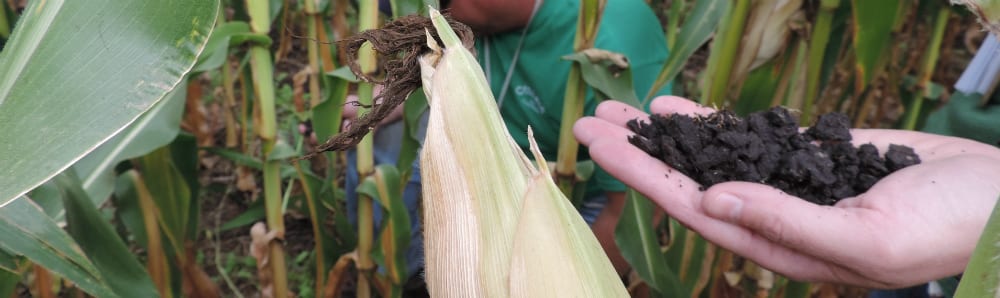
When you pick up a handful of soil, and it breaks apart into little pieces, you are looking at soil aggregates. Each aggregate is made up of soil particles of different sizes held together by both the attraction of soil particles and the binding of organic matter between soil particles.
Aggregate Formation
Soil organic matter holds aggregates together, making them stable and structural. At the same time, aggregates protect the organic matter from decomposition. Aggregates are broken down into microaggregates and macroaggregates; each class having specific benefits for soil health.
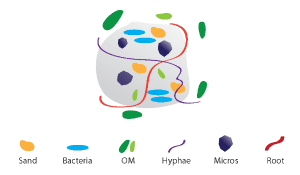
(1) Microaggregates are silt and clay particles tightly bound by organic materials. This providers a long-term pool for organic matter.
Breakdown Timeframe: decades/centuries
(2) Macroaggregates are a collection of silt/clay particles, microaggregates, and organic matter. Plant roots, mycorrhizae and earthworms are major contributors to the formation of macroaggregates. These larger aggregates have a shorter breakdown time, providing a organic matter source for roots, bacteria, and fungi.
Breakdown Timeframe: 1-10 years
How do Aggregates Work?
Aggregates store and supply organic matter in soil; however, they also have structural functions. Aggregate structures provided both large and small pores. Large soil pores allow water to quickly infiltrate the soil. Smaller soil pores can store plant available water in times of limited rainfall.
| ## Compacted Soil |
Managing Soil Aggregates
Management practices directly effect the level of soil aggregation. High-intesity tillage practices reduce aggregation; whereas, reduced or no-till systems facilitate aggregation.